

Water connects everything
From living landscapes to learning opportunities
By Cindy Eiritz
Guided by cultural responsibilities passed down through generations, Aboriginal and Torres Strait Islander Peoples have maintained deep knowledge of water and Country, including rivers, billabongs, wetlands, floodplains and surrounding landscapes.
I acknowledge their continuing custodianship and care for unceded Country and pay my respects to Elders past and present.
How a shared understanding of water, soil and living landscapes is creating new opportunities for environmental learning and landscape restoration.
What happens to rain when it reaches the ground? Does it soak into the soil, run off, evaporate or become part of a plant?
These questions open the door to a much bigger story about water and the living landscapes on which we depend.
Water connects everything. Yet our understanding of water often focuses on what we can see, like rivers, dams, rainfall and the water that flows from our taps. Less visible are the connections between soil, plants, landscapes and the atmosphere, and the role these relationships play in biodiversity, food production, climate regulation and water security.
For environmental educators, this offers opportunities to connect learning across disciplines as well as unearth hopeful climate solutions and how to restore our drying continent.
Behind this growing understanding are people who have spent decades learning how living landscapes work and how to restore them. Their work draws on different starting points, including First Peoples’ knowledge, practical experience and scientific research. This is the story of their work and their contributions embedded within our new teaching resource, the Green Water Detective Challenge.
Learning from Country, rehydrating landscapes
David Maher, a co-author of the Green Water Detective Challenge, sadly passed away two weeks ago. Much of his understanding of water and living landscapes came from the late Noonghaburra Elder Tex Skuthorpe, who taught him about Country and its interconnected living systems. Tex co-authored Treading Lightly: The Hidden Wisdom of the World’s Oldest People with Karl-Erik Sveiby. David carried that learning into his work.
David spent around 15 years working alongside Peter Andrews, learning from and contributing to his pioneering Natural Sequence Farming work. This approach slows and spreads water, reconnects floodplains and restores vegetation, supporting biodiversity, agriculture and resilience to drought and flooding.
David’s learning journey was remarkable. Over more than two decades, he combined hands-on experience, observation and citizen science with scientific study. His practical work grew into substantial research, earning international recognition for his contributions to landscape rehydration and living water cycles. Throughout, he recognised the importance of learning from Country.
In Rehydrating Australia: Towards a National Strategy for Heat Reduction, Water Security, and Climate Stability, David brought together evidence for landscape rehydration as part of Australia’s response to ecological decline, water insecurity and climate change. He also examined Indigenous water management and how colonisation disrupted custodianship and changed landscapes and waterways.
Different starting points, one living system
Our joint submission to the 2026 Independent Review of the Water Act 2007, Green Water, Terrestrial Hydrology and Australia’s Future Water Security, likewise calls for First Peoples’ knowledge and custodianship to inform water management and help restore healthy water cycles and resilient landscapes.
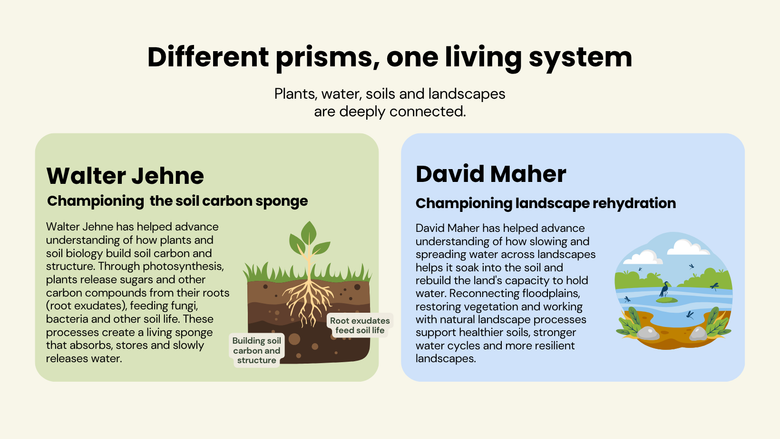
David approached the living system through water and landscape hydrology. Walter Jehne, an Australian forester, soil microbiologist, agronomist, climate scientist and innovation strategist, has helped bring attention to the relationships between soil, vegetation, water cycles and climate.
Walter has invested five decades learning and sharing. He has brought international attention to the soil carbon sponge and our potential to Regenerate Earth. His work helped inspire and he continues to nurture the Andhra Pradesh Community Managed Natural Farming initiative in India, where more than 1.8 million farmers, predominantly women, are improving soil health, food production and livelihoods. Walter also champions healthy soils, urban tree canopies and urban agriculture to cool cities and support biodiversity, as well as regenerative grazing to restore the health, biodiversity and resilience of rangelands.
Walter’s influence also extends through Biodiversity for a Liveable Climate, the Ecosystem Restoration Alliance, and their Climate Cooling Initiative. A presentation at Harvard University featuring Walter, that Bio4Climate organised,, has attracted more than 83,000 views.
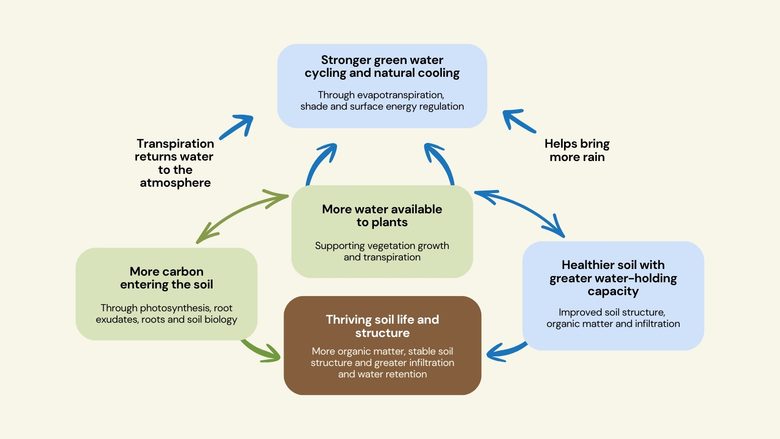
Walter and David understood the same living system from different starting points: Walter through the soil carbon sponge, David through water and landscape hydrology. The diagram shows how these processes connect. I feel deeply privileged to have learned from both and to help carry their work forward.
At AAEE’s recent Learning Circle, Water Connects Everything, Cynthia Mitchell AO, Professor Emerita at the University of Technology Sydney, presented work co-developed with Dr Katie Ross on biohydrology and the connections between green water, soils, plants and climate. Cynthia credited Walter with shaping much of their understanding.
[Learning Circle available to view by AAEE Members in the Resource library via your Member Portal.]
Where streams of knowledge converge
Knowledge of the connections between healthy soils, vegetation, water cycles and climate is opening new possibilities internationally. Streams of understanding and practice, developed and passed down over millennia, are converging.
These streams are coming together through a UN Green Water Flagship Initiative linking science, policy and practical action towards COP31 and the 2026 UN Water Conference.
In Australia, Cynthia and Katie have brought these ideas to the water and environment sectors. At AWA’s national Connected by Water conference in Perth in February 2026, they led an integrated programme on water’s role in cooling the climate. At that event and many others since, water and environment professionals, researchers and practitioners have been exploring how restoring living water cycles can cool landscapes and strengthen climate resilience.
Through this a national community of practice has begun to emerge, linking water utilities, catchments, government, engineering, research, planning and environmental management.
First Peoples also continue to lead important work grounded in their enduring relationships with water and Country. Examples include in the Kimberley, Professor Anne Poelina and the Indigenous-led Martuwarra Fitzroy River Council advocate for recognition of the Martuwarra (Fitzroy River) as a living ancestral being, with the right to live and flow.
And in Naarm (Melbourne), the Indigenous exhibition ngiyama mirrim baany yulendj | Reawakening Deep Water Knowledge at Melbourne Museum shares Boonwurrung knowledge of water and Country. Led culturally by Boonwurrung Elder Professor N’arweet Carolyn Briggs AM, it explores the waterways and wetlands beneath the modern city and how living cultural knowledge can guide the future of the city and our nation.
But how do we make these connections accessible to more people, including the next generation?
Bringing green water learning into schools
One way is to start with the places people already know. Find out the Indigenous name of your local river, creek or waterway, learn whose Country it flows through and explore its cultural significance with guidance from local First Peoples.
This is the spirit behind the Green Water Detective Challenge, a four week Primary School resource, developed by AAEE, the Australian Water Association (AWA) and Regenerate Earth.
This free four-week primary school resource invites students to investigate where rain goes, how plants move water, how water and vegetation affect local conditions, and how water moves through the wider landscape. They can make predictions, observe, record and share what they discover, without predetermined results.
The Challenge is being piloted in 2026. Teachers and environmental educators are invited to use, adapt and provide feedback on the resource.
Although the activities are designed specifically for primary school students, the ideas behind them are relevant much more broadly. The same questions about water, soil, vegetation and living systems can inform environmental learning in community settings, environmental education centres and other places where people connect with their local environments.
You’re invited to explore the free resource, try it in your setting and share feedback to help shape its future.